
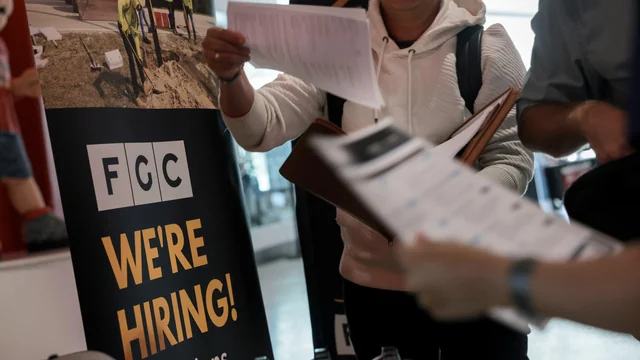
The U.S. labor market delivered stronger-than-expected job growth in April, but economists say the latest employment report still revealed several warning signs that could point toward a broader economic slowdown later this year.
According to data released by the Bureau of Labor Statistics, nonfarm payrolls increased by 115,000 jobs during the month. While the figure marked a slowdown from March’s revised gain of 185,000 jobs, it still exceeded economists’ expectations, which had projected roughly 55,000 new positions.
Despite the continued hiring activity, the unemployment rate remained unchanged at 4.3%, suggesting that the labor market may be entering a more stable but slower phase of growth.
Analysts noted that current labor market conditions no longer require extremely high levels of job creation to keep unemployment steady, largely because labor force growth has also slowed in recent months. This means fewer new workers are entering or re-entering the workforce compared to previous years.
While the headline payroll number appeared positive on the surface, economists pointed to several underlying concerns within the report. Hiring momentum has continued to cool compared with earlier periods of rapid post-pandemic recovery, and job gains are becoming more concentrated in fewer sectors of the economy.
Some experts believe the latest figures may reflect growing caution among employers facing higher interest rates, slower consumer spending, and ongoing uncertainty about future economic conditions. Businesses in certain industries have already started reducing hiring plans or slowing expansion efforts.
The labor market has remained one of the strongest pillars of the U.S. economy over the past few years, helping support consumer spending and economic resilience despite inflation pressures and aggressive interest rate increases from the Federal Reserve.
However, economists warn that weaker job growth over the coming months could eventually affect household spending, business confidence, and overall economic activity if the slowdown becomes more pronounced.
Financial markets and policymakers continue to watch labor market data closely, as employment trends remain a key factor in future interest rate decisions and broader economic forecasts.
Although the latest report showed the economy is still adding jobs, analysts say the slower pace of hiring indicates that the once red-hot labor market may gradually be cooling.

0 Comments