
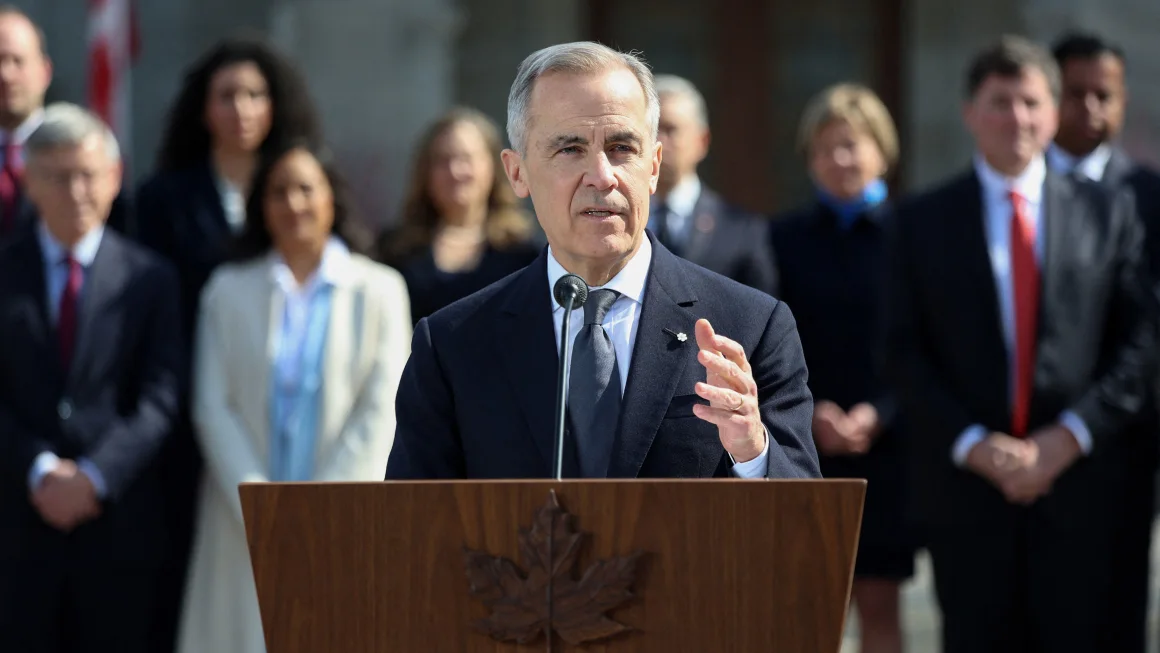
Here’s a polished version of your article with improved clarity, structure, and flow:
Mark Carney Sworn In as Canada’s Prime Minister – But His Toughest Challenges Lie Ahead
As Mark Carney takes office as Canada’s new prime minister, he faces two of the most complex political challenges of any world leader in recent years.
First, he is expected to call an immediate general election, aiming to capitalize on the resurgence of the Liberal Party after months of decline under former Prime Minister Justin Trudeau.
If he wins, his next challenge will be far more daunting: managing Canada’s fraught relationship with U.S. President Donald Trump. The experience of Ukrainian President Volodymyr Zelensky, who was thrust into a political firestorm in Washington, offers a stark warning of the difficulties Carney could face.
A Leader Forged by Crisis
Carney’s rise to power is a textbook example of the right man emerging at the right moment.
Were it not for Trump’s election victory and his unprecedented threats to absorb Canada as the “51st state,” Carney might still be a private citizen, and the Liberals could have been headed for political oblivion. But Trudeau’s resignation and a wave of Canadian patriotism, fueled by Trump’s attacks, left Conservative leader Pierre Poilievre—previously the frontrunner—struggling to regain his footing.
Carney, a former central banker, projects an image of steady leadership, billing himself as the experienced hand needed to navigate the worst crisis in U.S.-Canada relations in decades. His pragmatic, old-school approach contrasts with Poilievre’s populist, media-savvy style.
Yet, the very brand of conservatism that propelled Poilievre’s rise—his aggressive, Trump-style rhetoric—may now be his biggest weakness. The political landscape is shifting, and the appeal of reactionary politics appears to be fading.

A Backlash Against Backlash Politics
Poilievre’s struggles and Carney’s sudden prominence reflect a broader trend: Trump’s return was expected to fuel another wave of populist victories across the West. Instead, it has galvanized centrist leaders eager to push back against the chaos of “America First” politics.
In Britain, Prime Minister Keir Starmer, after a slow start, has used Trump’s resurgence to redefine his leadership. His embrace of Zelensky following the Ukrainian president’s bruising visit to Washington signaled a rejection of Trump’s influence. Meanwhile, France’s embattled President Emmanuel Macron has rebranded himself as a Gaullist statesman, advocating for European military independence. And in Germany, the rise of likely next chancellor Friedrich Merz marks a historic pivot away from U.S. post-war influence.
Even far-right movements appear to be losing ground. While Germany’s anti-immigrant AfD performed strongly in recent elections, overt support from Trump’s administration may have alienated some voters. In the UK, Nigel Farage’s Reform Party has distanced itself from Trump-era policies, while Marine Le Pen in France may face new hurdles in her long-running bid for the presidency.
Lessons for Carney
Macron and Starmer have refined the playbook for dealing with Trump: blending diplomatic flattery with a firm stance on policy disagreements. They have learned to correct his falsehoods in real time while maintaining working relationships.
Zelensky tried a similar approach but suffered a political beating in Washington before regaining favor at home. With European backing, he was able to call Trump’s bluff by agreeing to the former president’s proposed Ukraine ceasefire plan—turning Trump’s rhetoric against him.
For Carney, the stakes are even higher. Unlike Britain and France, Canada is facing direct threats to its sovereignty from Trump. Simply ignoring the controversy isn’t an option, especially if tensions with the U.S. linger into his expected election campaign.
Walking the Tightrope
Carney must also recognize a harsh economic reality: a trade war with the U.S. would devastate Canada far more than its larger neighbor. While nationalistic rhetoric may rally voters, he must avoid committing to positions that could make future negotiations with Trump impossible.
The answers may not come from Europe, but from Canada’s own history. At last weekend’s Liberal convention in Ottawa, 91-year-old former Prime Minister Jean Chrétien delivered a powerful speech that resonated with Canadians.
“I can say this from one old guy to another old guy,” he said, addressing Trump directly. “Stop this nonsense. Canada will never join the United States.”
Yet even amid his strong rhetoric, Chrétien left the door open for diplomacy:
“We have worked with and collaborated with the United States in the past, and I’m telling you, we will do so in the future.”
For Carney, that may be the best strategy—projecting strength while keeping open the possibility of a necessary reconciliation.
With a likely snap election ahead, he will have little time to strike that balance.

0 Comments