
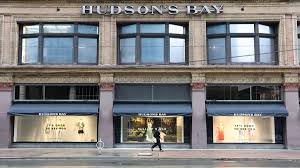
Toronto, Canada — Hudson’s Bay, Canada’s oldest retailer, has announced plans for an immediate liquidation of its entire business, citing financial struggles and an inability to secure necessary funding. Retail analysts warn that the closure will leave a significant gap in the country’s retail landscape, as the iconic department store prepares to wind down operations over the coming months—unless a last-minute solution emerges.
Historic Retailer Faces Closure
The company, which dates back to 1670 and operates 80 stores across Canada, revealed on Friday night that it would begin liquidation as early as next week, pending court approval.
Despite extensive efforts to find financing, Hudson’s Bay stated that it had no viable options left to keep parts of the business alive. The retailer is now set to appear in court on Monday, where a full liquidation plan will be reviewed. If approved, operations will wind down completely by June, resulting in widespread job losses and vacant commercial spaces in major shopping districts.
Impact on Employees and Retail Market
The closure would affect approximately 9,364 employees across Hudson’s Bay stores, as well as three Saks Fifth Avenue locations and 13 Saks Off 5th outlets, which the company operates through a licensing agreement.
Retail strategist Liza Amlani noted that the company’s decline has been apparent for some time, pointing to neglected store maintenance, reduced operating hours, and outdated business strategies. “The writing has been on the wall,” she said. “It’s really unfortunate because of the number of employees and customers affected.”
She highlighted issues such as non-functioning escalators, unresolved air-conditioning problems, and store hours misaligned with the malls they were housed in—factors that contributed to customer dissatisfaction.
Financial Challenges and Mismanagement
Despite its deep roots in Canadian history, Hudson’s Bay has been under American ownership for decades. The company was acquired in 2008 by real estate investor Richard Baker’s National Realty and Development Corp. for $1.1 billion.
According to marketing expert Joanne McNeish, this marked a turning point in the company’s downfall. “Investment firms are like house flippers. They rarely address underlying business issues,” she said, adding that profit-driven strategies stifled long-term growth.
After being taken public in 2012, Hudson’s Bay returned to private ownership in early 2020, just before the COVID-19 pandemic. This left the company vulnerable to economic downturns, shifting consumer behavior, and trade tensions between Canada and the U.S.
Legal Proceedings and Future Uncertainty
Documents filed with the Ontario Superior Court on Friday indicate that Hudson’s Bay intends to liquidate its assets over the next few months, possibly through an auction if multiple qualified bids emerge. The company has secured only limited debtor-in-possession financing, which allows for restructuring but not long-term survival. Without immediate liquidation, it is unlikely that Hudson’s Bay would be able to meet its financial obligations.
In her affidavit, Jennifer Bewley, Chief Financial Officer of Hudson’s Bay’s parent company, emphasized that the liquidation process must conclude by June 15 due to the company’s limited liquidity.
Hudson’s Bay’s financial filings reveal that it owes over $950 million to creditors, including major fashion brands such as Ralph Lauren, Chanel, Columbia Sportswear, Diesel, and Estee Lauder.
Calls for Worker Protections
On Saturday, the union representing about 320 workers at Hudson’s Bay locations in Windsor, Kitchener, Sherwood Gardens, and the company’s Toronto e-commerce warehouse urged the retailer to fulfill its legal obligations to employees. Unifor National President Lana Payne stressed the importance of ensuring fair severance and benefits for affected workers.
“HBC must act in good faith,” Payne said in a statement. “Workers’ livelihoods are on the line, and they deserve full transparency from the company.”
The Fallout of a Retail Giant’s Closure
A full liquidation of Hudson’s Bay will leave large anchor spaces vacant in malls and prime retail districts, significantly impacting the commercial real estate market. Many of these stores, particularly in Ontario, British Columbia, and Alberta, occupy multiple floors and serve as flagship locations.
Retail experts believe that unless a buyer emerges to salvage parts of the business, Canada’s retail sector will feel the void left by the loss of one of its most historic brands.
For now, Hudson’s Bay is holding out hope for a last-minute rescue. However, as liquidation plans move forward, the company’s 354-year legacy appears to be coming to an end.

0 Comments