
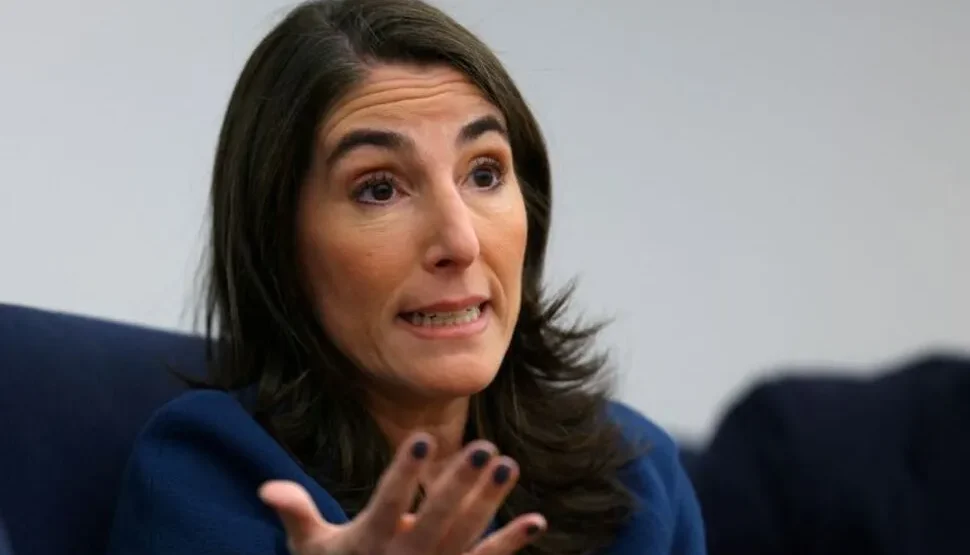
Rising oil prices and economic uncertainty are complicating the U.S. Federal Reserve’s fight against inflation. However, Cleveland Federal Reserve President Beth Hammack said the central bank must continue pushing inflation lower toward its target.
Hammack emphasised that the Fed must remain focused on its 2% inflation goal, even as global developments create new economic risks. Meanwhile, policymakers are watching both inflation data and labour market trends closely.
📉 Fed Prioritises Inflation Target
Hammack explained that the Federal Reserve must ensure inflation continues moving toward the 2% target. Therefore, policymakers will closely evaluate incoming economic data before adjusting interest rates.
She noted that the central bank expects inflation pressures to moderate over time. However, officials remain cautious because new shocks could slow that progress.
“The central bank must ensure inflation returns to its target,” Hammack said while discussing current policy challenges.
As a result, the Fed may keep its current policy stance until clearer trends appear.
🛢️ Oil Price Surge Adds Uncertainty
Meanwhile, rising oil prices have introduced new uncertainty for policymakers. Energy costs have climbed due to geopolitical tensions, which can quickly push consumer prices higher.
Consequently, higher fuel prices could complicate the Fed’s effort to stabilise inflation. At the same time, officials must determine whether the oil surge represents a temporary shock or a longer-term risk.
Hammack stressed that the Fed must examine both the magnitude and duration of the oil price increase before changing policy.
👷 Labour Market Weakness Raises Concerns
At the same time, the labour market has shown signs of slowing. New economic data revealed that the U.S. economy lost around 92,000 jobs in February, raising concerns about employment trends.
This development creates a difficult policy environment. On one hand, the Fed must control inflation. On the other hand, weaker job growth could require economic support.
Therefore, policymakers must carefully balance price stability and employment, the two goals of the Federal Reserve’s mandate.
⚖️ Policy Decisions May Depend on Late-2026 Inflation
Hammack said the Fed expects inflation to ease gradually. However, she warned that the central bank could adopt tighter policy later in 2026 if inflation fails to decline sufficiently.
For now, the Fed appears willing to hold interest rates steady while monitoring economic conditions. Meanwhile, officials will continue analysing how energy prices, labour data, and global developments affect inflation.
Consequently, the coming months will play a key role in shaping the Federal Reserve’s next policy decisions.

0 Comments