
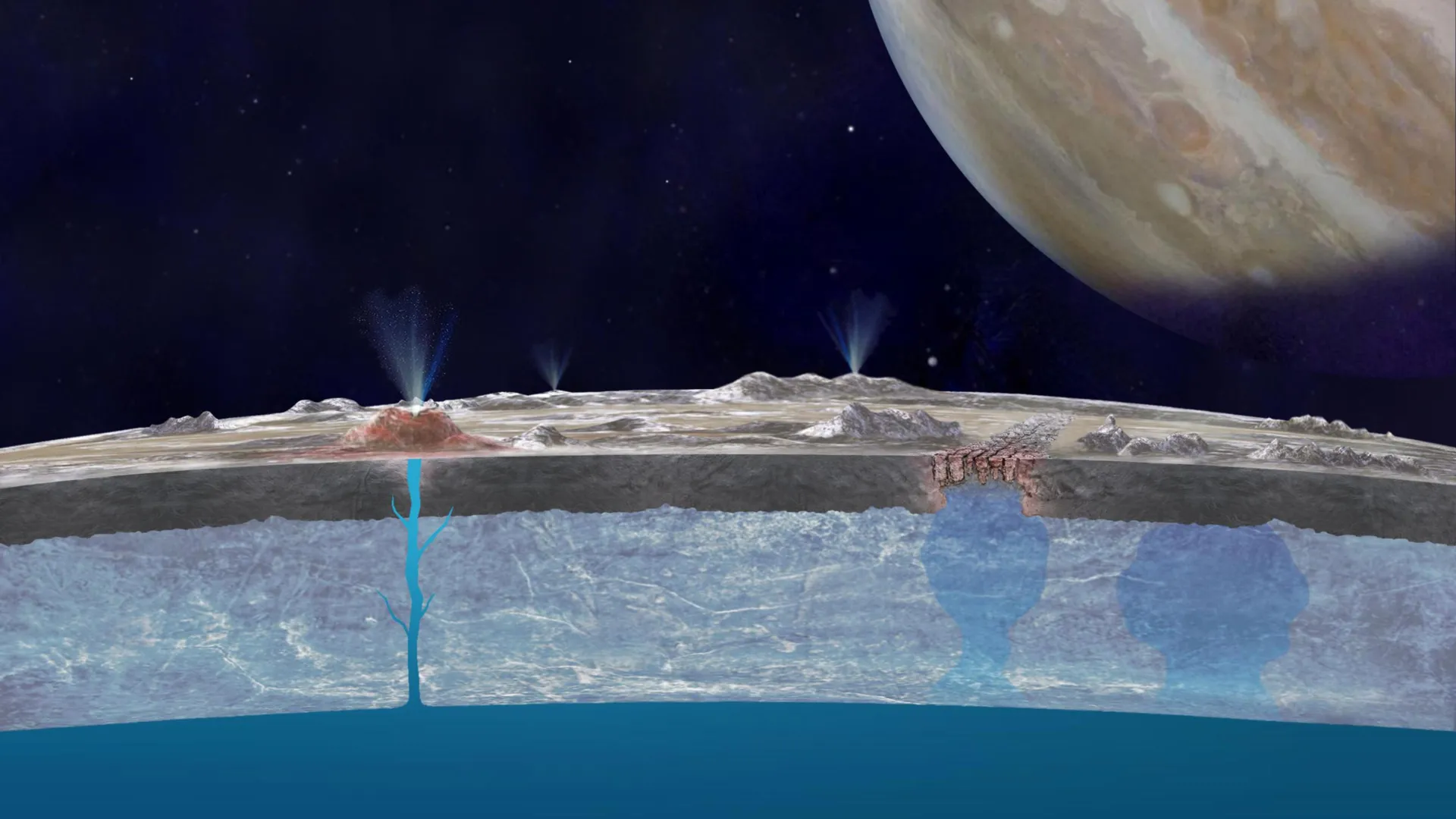
New research suggests that ice on Jupiter’s moon Europa may deliver nutrients into its hidden subsurface ocean. Scientists found that salty surface ice could become dense enough to sink through the ice shell. This process may help transport materials that could support life below the surface.
Europa contains more liquid water than all of Earth’s oceans combined. However, a thick ice layer blocks sunlight from reaching the ocean. As a result, any life would require alternative sources of energy and nutrients.
🌌 Why Nutrient Transport Matters
Europa’s surface faces intense radiation from Jupiter. This radiation alters surface salts and chemicals, producing compounds that may serve as nutrients. However, most ice motion on Europa occurs sideways, not downward. Therefore, scientists have questioned how these surface materials could reach the ocean.
Without a vertical transport process, nutrients might remain trapped near the surface. That challenge has limited estimates of Europa’s habitability for decades.
🔬 Earth-Inspired Geological Process
To address this problem, researchers studied a process known on Earth as crustal delamination. On Earth, altered or compressed crust can become dense and sink into deeper layers. Scientists proposed that a similar mechanism could operate within Europa’s ice shell.
They suggested that ice enriched with salt could grow heavier than the surrounding ice. Once dense enough, it could detach and sink downward.
🧪 Computer Models Support the Theory
Researchers tested this idea using computer simulations. The models showed that salt-rich ice could sink through Europa’s shell under a wide range of conditions. Even modest weakening of surface ice allowed downward movement.
As a result, surface materials could recycle into the ocean below. This process could repeat over long periods, offering a steady supply of nutrients.
🌊 Implications for Europa’s Ocean
The sinking ice may carry oxidants and other chemical compounds into the ocean. These substances could provide energy for potential microbial life. Therefore, the study strengthens the idea that Europa’s ocean may remain chemically active.
Importantly, the process does not require large cracks through the ice shell. Instead, it relies on gradual sinking driven by density differences.
🚀 Relevance to Future Space Missions
The findings align closely with the goals of NASA’s Europa Clipper mission. The spacecraft aims to study Europa’s ice shell, ocean and surface composition. Understanding nutrient transport will help scientists interpret future observations.
By identifying a realistic pathway for surface materials to reach the ocean, the research adds important context for upcoming exploration.
🔭 Next Research Directions
The study focused on theoretical models rather than direct observation. However, the results guide future mission planning and data analysis. Scientists plan to refine these models as new data becomes available.
For now, the research offers a strong explanation for how Europa’s ocean could receive the materials needed to support life.

0 Comments