
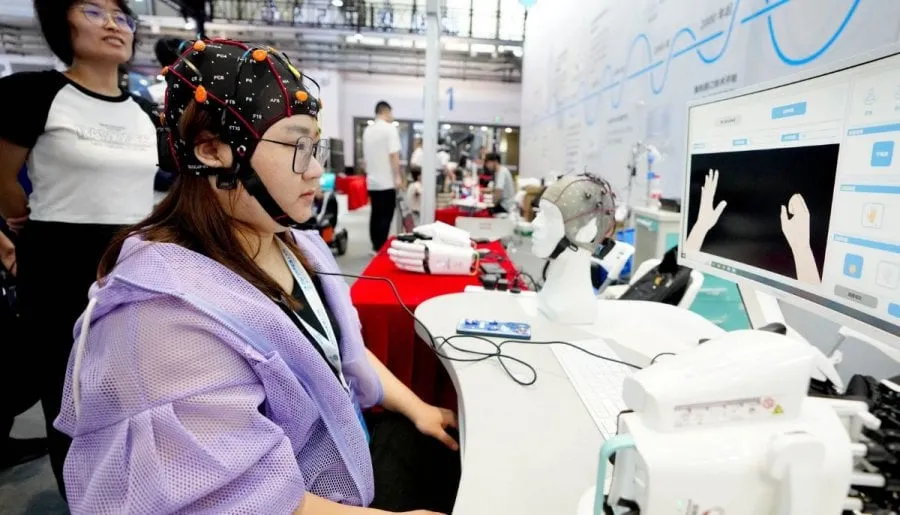
China’s drug regulator has approved the world’s first brain-computer interface medical device for commercial use. The approval marks an important step in the development of neurotechnology.
The National Medical Products Administration authorised the device for market launch. The system aims to help patients with paralysis regain certain hand movements.
Meanwhile, the technology was developed by Borui Kang Medical Technology (Shanghai). The company designed the system to restore motor functions in patients with severe spinal injuries.
As a result, the approval represents a major milestone in medical technology and neural engineering.
🤖 Device Connects Brain Signals to Hand Movement
The brain-computer interface works by linking signals from the brain to external devices. Consequently, patients can control certain movements through neural activity.
The system targets people with quadriplegia caused by cervical spinal cord injuries. In addition, it allows patients to regain hand-grasping ability using a wearable glove connected to the device.
Unlike non-invasive systems, this technology uses an invasive interface with implanted electrodes. These electrodes capture brain signals with greater precision.
However, the implantation method remains minimally invasive. Doctors place electrodes in an extradural position, which avoids deeper penetration of brain tissue.
Furthermore, the system transmits signals wirelessly between the brain implant and the external equipment.
📊 Clinical Trials Show Improvements for Patients
Clinical trials demonstrated encouraging results during the testing phase. According to the regulator, patients showed significant improvement in their ability to grasp objects. Therefore, the device could help restore a degree of independence for people living with paralysis.
However, only specific patients qualify for the treatment.
Participants must be between 18 and 60 years old and suffer from cervical spinal cord injuries. In addition, their condition must remain stable for at least six months.
Doctors must also confirm that the patient lost the ability to grasp objects with their hands. At the same time, patients must still retain some upper-arm movement.
These criteria help ensure the device works effectively for suitable candidates.
🚀 China Expands Focus on Brain-Computer Technology
China has identified brain-computer interface technology as a future strategic industry. Therefore, the government has included the sector in national development plans.
Researchers expect the technology to progress rapidly over the next few years. In addition, experts believe practical applications could expand within three to five years.
Meanwhile, several global companies and research institutions are developing similar technologies. These efforts reflect growing international interest in neural interface systems.
Consequently, the approval places China among the early leaders in commercialising brain-computer interface technology.
The development also highlights the increasing role of advanced technology in modern medical treatment.

0 Comments