
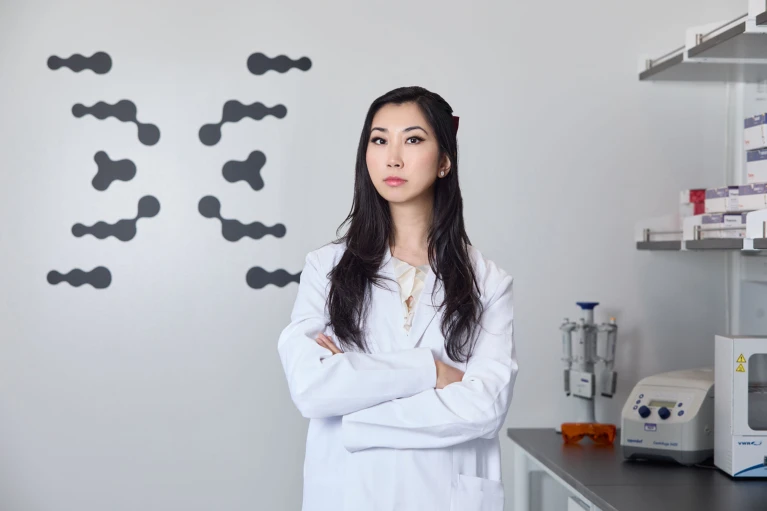
Biotech entrepreneur Cathy Tie, who famously left university at 18 to launch her first startup, is taking her most controversial leap yet. Her new company, Manhattan Genomics, aims to develop technologies to edit the genomes of human embryos — potentially paving the way for future CRISPR-engineered babies free from inherited diseases.
Tie, sometimes playfully dubbed “Biotech Barbie”, has compared her ambitions to the Manhattan Project, signalling the scale and disruptive intent of her vision. On 30 October, she announced key hires, including a bioethicist and scientists specializing in non-human primate reproduction — expertise that suggests long-term plans for safety testing before any attempt at implantation.
“We have a duty to patients with incurable, debilitating diseases,” Tie said. “A majority of Americans are in support of this technology.”
She co-founded the New York-based company with Eriona Hysolli, formerly of Colossal Biosciences. Another firm, Preventive, headquartered in South San Francisco, has also revealed plans to explore embryo gene editing.
⚠️ Scientists Warn: “We’re Not Ready”
Despite interest in heritable gene editing, most scientists remain cautious — if not alarmed.
“The bar for safety is so, so, so, so high,” says Alexis Komor, biochemist at UC San Diego. “We’re definitely not there yet.”
Experts point out that manipulating the genome of embryos carries unique and irreversible risks. Unlike gene therapies in children or adults, editing embryos affects every cell in the body — and passes changes to future generations.
Common dangers include:
- unpredictable DNA edits or mutations
- lifelong health consequences
- transmission of unknown genetic risks to descendants
Additionally, many inherited disorders can already be avoided through embryo genetic screening, reducing the medical need for editing.
🧬 Lessons From the First CRISPR Babies
The field is still haunted by the 2018 case of He Jiankui, who secretly edited embryos in China to resist HIV, leading to the birth of twin girls. The global scientific community condemned the experiment, and He served prison time for illegal medical practice.
Tie briefly had a personal association with He earlier this year, but says they are no longer connected and he has no role in her company.
Countries including the United States maintain strict boundaries:
- no federal funding for human-embryo editing research
- no FDA approval allowed for edited embryos in clinical use
🚀 Technology Has Advanced — But Risks Remain
Tie and Hysolli argue that advances in tools such as base editing and prime editing — which can modify DNA without cutting both strands — mark a new era of precision. These innovations aim to reduce unintended DNA damage once associated with early CRISPR methods.
Still, researchers say unknowns remain too great to move toward commercial applications or baby creation.
“A lot of new advances have happened to make gene editing safer and more accurate,” Tie maintains.
🧭 The Ethical Frontier
As embryo editing inches from science fiction toward feasibility, the debate intensifies:
Should humanity correct devastating genetic diseases at the embryo stage — or are we opening the door to irreversible harm and designer babies?
For now, the scientific consensus remains firm: not yet.
But companies like Manhattan Genomics suggest that pressure — technological, financial and emotional — to cross the threshold is mounting.

0 Comments