
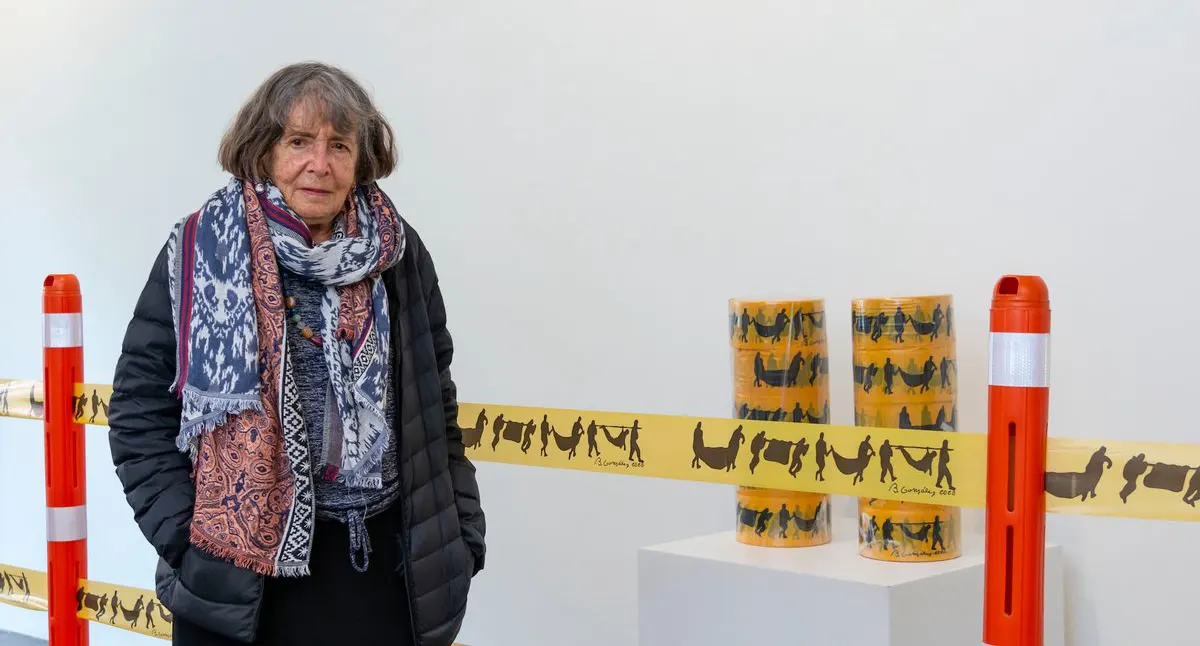
Beatriz González died in Bogotá on 9 January 2026 at the age of 93. Her death marked the conclusion of a career that influenced Colombian art for more than six decades. She was born in 1932 in Bucaramanga, therefore entering the art world during a period of institutional and cultural transformation in Colombia.
She first enrolled in architecture at the Universidad Nacional de Colombia. However, she soon redirected her studies toward fine arts at the Universidad de los Andes. As a result, her training combined technical structure with visual analysis, which later shaped her artistic language.
🖼️ Artistic Direction and Practice
From the early 1960s onward, abstraction dominated Colombian art. Meanwhile, figurative approaches received less institutional attention. In contrast, González embraced figuration and visual repetition drawn from everyday sources.
She consistently used images from newspapers, official portraits, and printed reproductions. Therefore, her work reflected how images circulate within Colombian society. Although critics frequently compared her to Pop artists, she rejected that classification. Instead, she emphasised local references and cultural specificity.
Her 1965 series Los Suicidas del Sisga marked a defining moment. The works reinterpreted press photographs of a widely reported tragedy. Consequently, the series examined how media images shape public memory without altering the original visual source.
🏛️ Institutional and Curatorial Roles
Alongside her studio work, González contributed extensively to Colombia’s museum sector. She participated in the founding of the Museo de Arte Moderno de Bogotá in 1963. Soon after, she presented her first solo exhibition there in 1964, therefore establishing an early institutional presence.
She later created a structured programme for museum guides. As a result, public engagement with art expanded through education. From 1989 to 2004, she served as chief curator of the Museo Nacional de Colombia, where she supported research into historical art collections and political caricature.
📚 Scholarship and Public Work
In addition to curatorial duties, González pursued academic research. She studied 19th-century Colombian art and visual satire, thereby contributing to historical documentation.
Her public installation Auras anónimas addressed themes of death and remembrance. Meanwhile, the project reflected her long-standing focus on collective loss. Throughout her career, she combined artistic production, scholarship, and institutional leadership. Consequently, her influence extended beyond exhibitions into education and museum practice.
Her work and teaching continue to shape Colombian art history.

0 Comments