
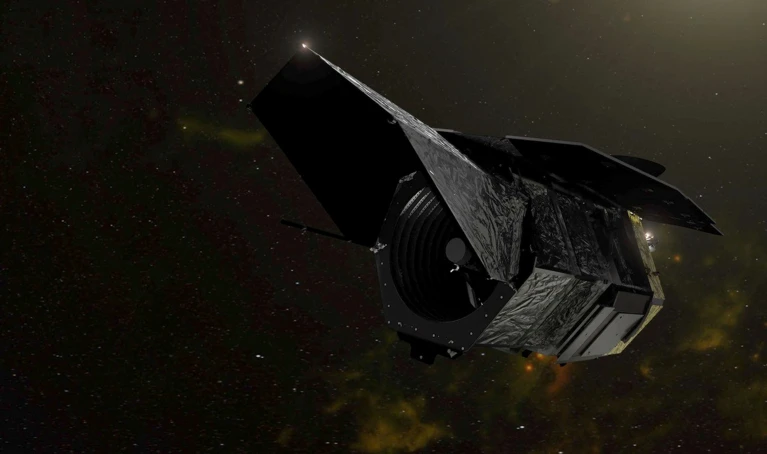
NASA has successfully launched the Nancy Grace Roman Space Telescope, a $4.3bn flagship observatory designed to investigate some of the biggest mysteries of the Universe, including the nature of dark energy.
The telescope lifted off aboard a SpaceX rocket at 7:35 a.m. local time on 30 August from NASA’s Kennedy Space Center in Florida. Following a successful launch, the observatory entered orbit and will begin travelling towards its final destination.
Roman carries the largest infrared digital camera ever built for space, along with a massive mirror originally designed for a spy satellite. Together, the instruments will allow scientists to observe enormous areas of the Universe while maintaining exceptionally sharp resolution.
One of Roman’s biggest advantages is its expansive view of space. Its field of view is expected to be roughly 100 times larger than that of the Hubble Space Telescope, allowing astronomers to survey huge numbers of galaxies, stars and other celestial objects.
Scientists hope Roman will provide new evidence about dark energy, the mysterious phenomenon associated with the accelerating expansion of the Universe. The telescope is also expected to observe millions of stars in the Milky Way and help researchers discover and study planets orbiting distant stars.
The observatory is named after Nancy Grace Roman, NASA’s first chief astronomer, who played an influential role in the agency’s major scientific programmes and helped lay the foundations for the Hubble Space Telescope.

0 Comments