
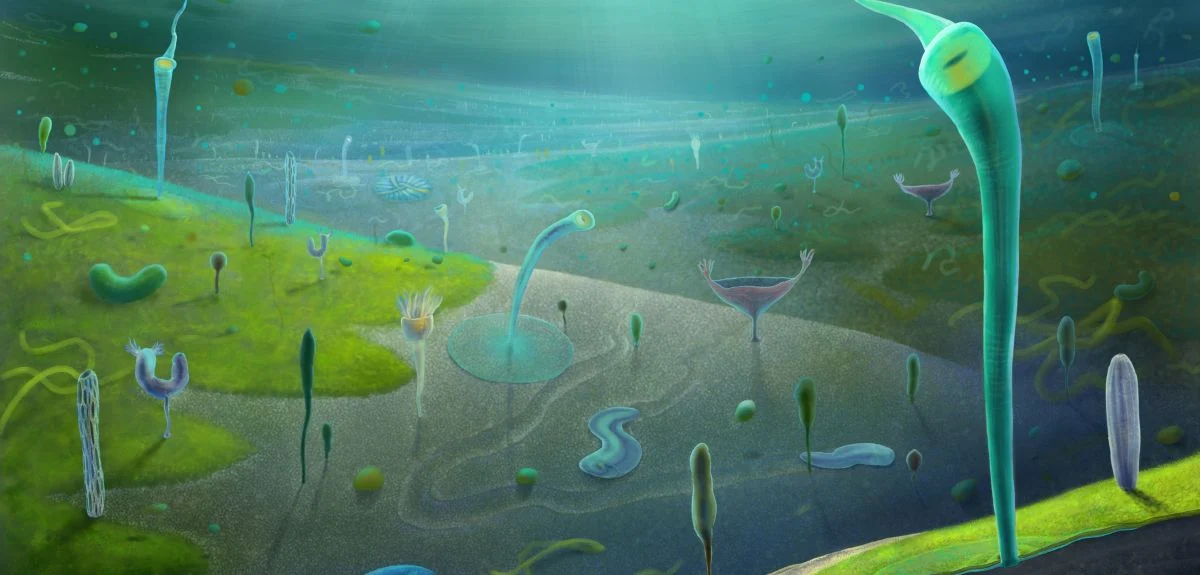
Scientists from the University of Oxford have uncovered a remarkable fossil site that is reshaping understanding of how complex animal life evolved. The discovery reveals that many advanced animal groups existed millions of years earlier than previously believed.
The fossils were found in southwest China’s Yunnan province, in a site known as the Jiangchuan Biota. Therefore, this finding challenges long-standing assumptions about the timing of early animal evolution.
The discovery shows complex animals evolved earlier than fossil records suggested.
📊 Over 700 Fossils Reveal Early Diversity
Researchers uncovered more than 700 fossil specimens, dating between 554 and 539 million years ago. These fossils show a wide variety of organisms, including both previously known groups and entirely new forms.
Therefore, the site provides one of the most detailed records of early animal life. Meanwhile, it reveals a diverse ecosystem that existed before the well-known Cambrian explosion.
At the same time, many fossils display complex anatomical features, such as feeding structures and body symmetry. Consequently, scientists now believe that early animal evolution was more advanced than previously thought.
🧬 Evidence of Early Complex Animal Groups
One of the most significant findings involves fossils linked to deuterostomes, a group that includes modern animals such as fish and humans. These fossils represent the oldest known relatives of this group.
Therefore, the discovery pushes back the origin of these organisms into the Ediacaran period. Previously, scientists believed such complexity appeared only during the Cambrian period.
Meanwhile, researchers also identified early forms related to starfish and acorn worms, as well as worm-like animals with advanced feeding systems.
As a result, the findings show that major animal groups were already developing earlier than expected.
🌍 Shifting the Cambrian Explosion Timeline
The Cambrian explosion, which began around 535 million years ago, has long been seen as the moment when complex life rapidly appeared. However, this new evidence shifts that timeline back by at least four million years.
Therefore, scientists now believe that the evolution of complex animals was a gradual process rather than a sudden event.
Meanwhile, the fossil site represents a transitional ecosystem, where simpler life forms coexisted with more advanced organisms. Consequently, it helps bridge a major gap in evolutionary history.
⚙️ Exceptional Fossil Preservation
Unlike many older fossil sites, the Jiangchuan fossils are preserved as carbon-based films. This rare preservation method allows scientists to observe fine anatomical details, including internal structures.
Therefore, researchers can study how these early animals lived and functioned. At the same time, it suggests that similar organisms may have existed elsewhere but were not preserved.
As a result, the apparent absence of complex animals in earlier records may reflect preservation limitations rather than true biological absence.
🔍 Implications for Evolutionary Science
The discovery helps resolve a long-standing scientific puzzle. Previous genetic and trace evidence suggested that complex animals evolved earlier, but fossil proof was limited.
Now, this fossil trove provides direct physical evidence supporting those theories. Therefore, it strengthens the idea that early animal life diversified before the Cambrian period.
Meanwhile, researchers expect the site to remain a focus of study for years. As a result, further analysis may reveal even more insights into early evolution.
🌱 A New Understanding of Early Life
Overall, the findings show that early animal evolution was more gradual and complex than previously believed. Therefore, the study changes how scientists understand one of the most important periods in Earth’s history.
At the same time, it highlights the importance of new fossil discoveries in refining scientific knowledge. Consequently, the Jiangchuan Biota may become one of the most significant fossil sites ever studied.

0 Comments