
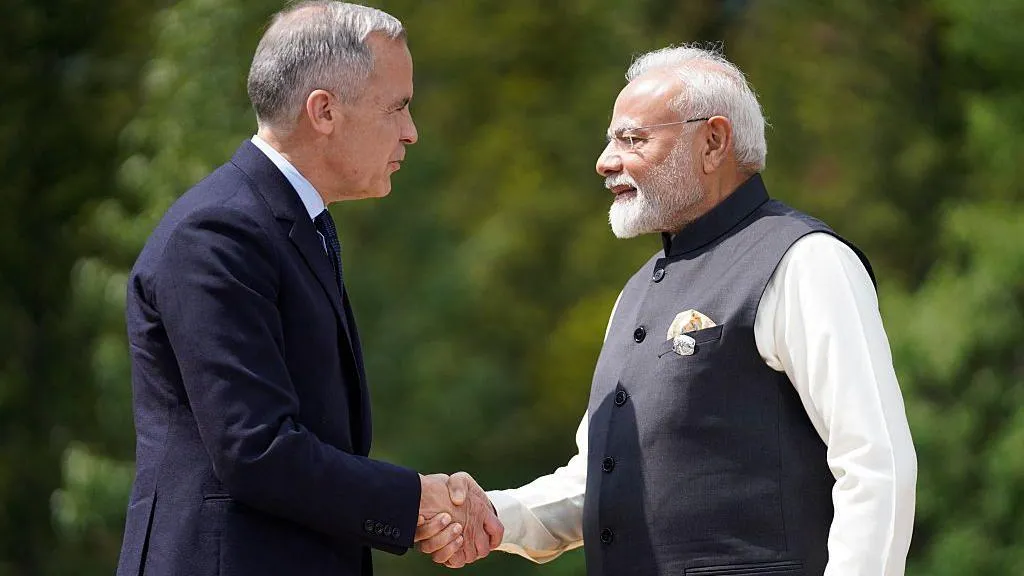
Canadian Prime Minister Mark Carney arrived in Mumbai, India, on Friday, beginning his first official visit to the country. The trip aims to boost Canada-India trade, mend strained relations, and expand economic cooperation. Carney’s visit is part of a broader effort to position Canada more strongly on the world stage by building new global partnerships outside its traditional reliance on the United States.
He met business leaders in Mumbai before travelling to New Delhi for planned discussions with Indian Prime Minister Narendra Modi. Together, they are expected to explore ways to deepen economic ties and improve access for Canadian exports.
📈 Expanding Trade and Economic Cooperation
Carney’s visit focuses on expanding trade and investment between Canada and India. Officials say both countries will work on advancing negotiations for a comprehensive trade agreement. The agreement could set a framework for reducing tariffs and encouraging deeper economic exchange. India is one of the world’s fastest-growing major economies, while Canada seeks new markets for goods such as energy, agriculture and technology.
Carney has emphasised that Canada wants to reduce dependence on the United States for trade. As a result, he is pursuing new partnerships across Asia and the Indo-Pacific. India is a key part of that strategy because it presents a large consumer market and growing demand for Canadian resources and expertise.
🤝 Easing Diplomatic Tension
Relations between Canada and India faced strain in recent years. The tension stemmed from accusations made by Canada’s previous government that India was involved in the killing of a Canadian Sikh activist. India has firmly denied any involvement.
Analysts see Carney’s visit as a reset in diplomatic relations. Unlike his predecessors, he chose not to visit India’s Punjab region, which could have stirred sensitive political sentiment among Sikh communities. Instead, he is focusing on economic cooperation and pragmatic ties.
Leaders in both nations want to move beyond past disagreements and build a partnership that supports shared goals, including inclusive economic growth and stable governance. Carney’s presence in India demonstrates Canada’s willingness to engage constructively on key trade and investment opportunities.
📊 Business Engagement and Investment Goals
During his visit, Carney is meeting with Indian business leaders and industry representatives. These engagements aim to foster investment opportunities and build confidence among global investors. Canadian pension funds and financial institutions are also expected to deepen their involvement across sectors such as technology, clean energy, infrastructure, and critical minerals.
Officials say Canada’s diversified economic strategy includes focusing on industries where both countries may benefit from cooperation. Canada’s strong sectors in energy and natural resources might find demand in India’s fast-growing economy, while Indian companies could invest in Canada’s technology and services sectors.
🌏 Broader Diplomatic Context
Carney’s visit to India is not a standalone event. It forms part of a broader diplomatic tour that includes visits to Australia and Japan. This tour reflects Canada’s effort to strengthen its global network of partners and reduce dependence on a single major market.
Canada’s plan is to adapt to shifting global trade patterns, where nations increasingly seek diversified economic relationships. At the same time, India aims to attract overseas investment and support long-term economic growth.
🧭 What to Watch Next
Canadian and Indian officials have not announced final decisions on the comprehensive trade agreement. However, negotiations are expected to continue as both countries build momentum on economic cooperation.
If discussions progress, improved market access could benefit Canadian exporters and Indian investors. Furthermore, stronger bilateral ties may pave the way for future cooperation in sectors such as technology, education, energy, and culture.

0 Comments