
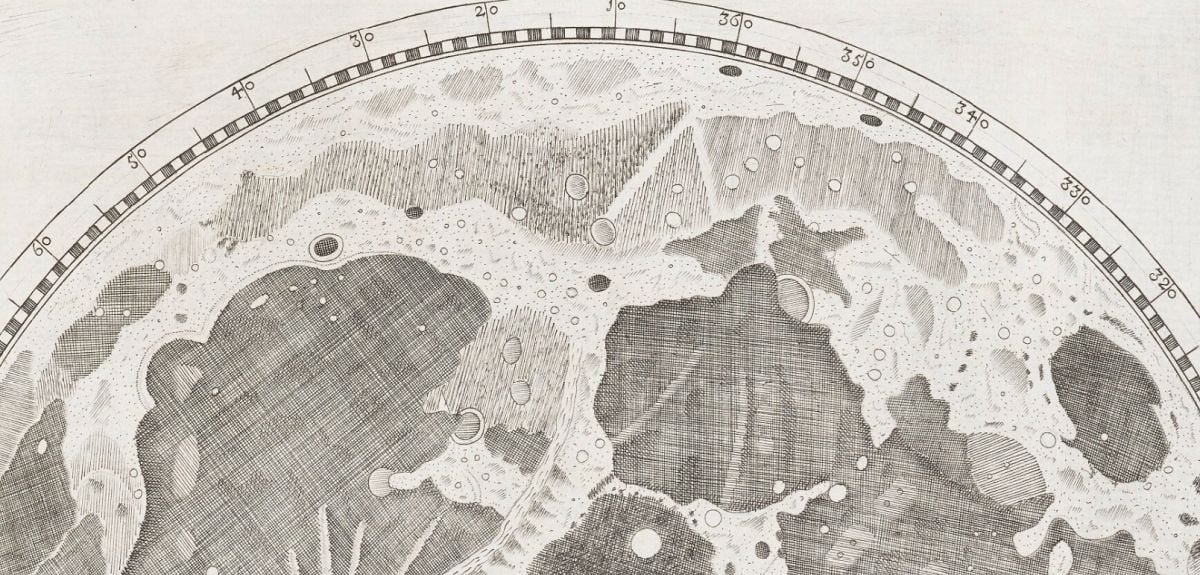
The oldest known detailed map of the Moon — drawn in 1647 by astronomer Johannes Hevelius — has been fully digitised by the Bodleian Libraries at University of Oxford. The atlas, titled Selenographia, sive Lunae descriptio, once available only to those visiting in person, is now freely accessible online via Oxford’s digital platform — allowing anyone, anywhere, to explore its detailed engravings and maps of the lunar surface.
The original atlas comprises 111 plates and engravings showing the Moon in every conceivable phase, plus a composite map depicting the lunar surface as if uniformly lit. These maps dispelled the myth that the Moon’s surface was smooth — instead showing craters, valleys and mountains in remarkable detail. At the time of publication, it became a foundational reference for lunar cartography.
🔭 Hevelius: Self-Taught Astronomer Who Redrew the Moon
What makes this achievement even more extraordinary is that Hevelius was not a professional astronomer by trade. He was a merchant, city councillor and later mayor in Gdańsk (then in the Polish–Lithuanian Commonwealth), who built his own observatory on the roofs of his houses. Using telescopes and handmade instruments, he observed the Moon night after night for years — then created the atlas by hand.
Scholars at Oxford note that many of the names Hevelius assigned to lunar mountains, craters and terrains are still in use today — a testament to the atlas’s lasting influence.
As one archivist described:
“Selenographia is a treasure on several levels … it has tremendous scientific value … and is also strikingly beautiful.”
🌐 Digitisation Unlocks Global Access, Preserves History
Previously, viewing the atlas required special permission and physical presence in Oxford. Now, thanks to a high-resolution digitisation project, users worldwide can zoom in on engravings, examine lunar terrain in detail, and study the work’s artistic and scientific merit at leisure.
The digitisation also serves a preservation role. The original pages are centuries old, and digitising them reduces wear from handling — safeguarding a key artefact of early astronomy for future generations. As one Oxford librarian put it:
“Digitising collections fulfils many key purposes … opening up the knowledge they contain to the world.”
The project adds to a growing trend of making rare, archival scientific works accessible digitally — lowering barriers for researchers, educators, and enthusiasts worldwide.
🌟 Why This Matters: Science, Culture and Education
This digitisation project resonates across multiple domains:
- Historical astronomy — It gives modern scientists and historians access to maps that shaped early lunar studies.
- Public engagement and education — Students, educators, and space-enthusiasts from anywhere can explore 17th-century observations without needing to travel.
- Preservation — It helps protect rare historical documents by reducing physical handling and exposure.
- Global accessibility — The digital atlas democratizes access to knowledge, allowing a global audience to study and appreciate early scientific achievements.
For many, it bridges centuries — connecting the night-sky watchers of the 1600s with today’s digital and space-exploration era.

0 Comments