
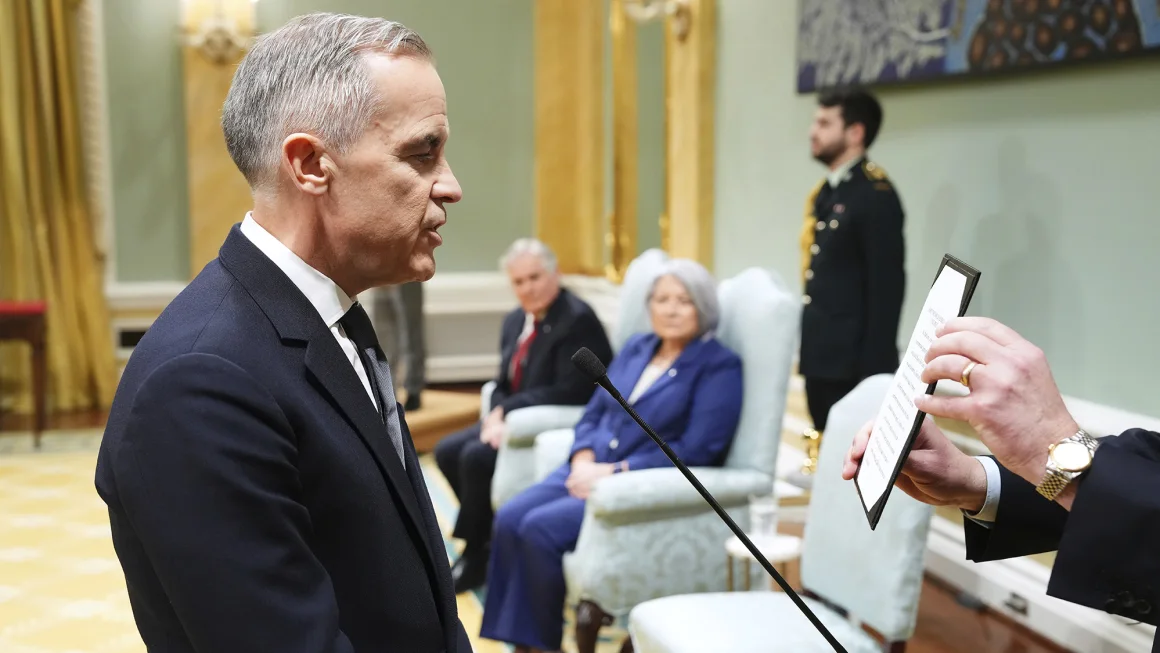
Mark Carney has officially been sworn in as Canada’s new Prime Minister, taking over from Justin Trudeau in a moment of political and economic uncertainty. The former central banker steps into the role at a critical juncture, with Canada facing escalating tensions with the United States under President Donald Trump and an increasingly volatile trade relationship with its largest economic partner.
Carney, who has never before held public office in Canada, assumes leadership of the Liberal Party and the country at a time when his economic and diplomatic skills will be tested. His immediate challenges include managing Canada’s sovereignty amid pressure from the U.S., addressing a brewing trade war, and preparing for a national election later this year.
A Defiant Stance on Sovereignty
In his first speech as Prime Minister, Carney took a firm stance on Canada’s independence in response to President Trump’s controversial suggestions that Canada should become the 51st U.S. state. The statement, which has stirred political debates on both sides of the border, was met with a strong rebuttal from Carney.
“We will never, ever, in any way, shape, or form, be part of the United States,” Carney declared. “America is not Canada, and Canada is not America. We are a proud, independent nation, and that will never change under my leadership.”
His comments come after repeated remarks from Trump that hinted at the idea of closer political integration between the two nations. While widely dismissed by Canadian politicians and policy experts as unrealistic, these statements have fueled concerns about the growing influence of U.S. policies on Canadian affairs.
Carney also made it clear that, for the time being, he has no immediate plans to visit Washington, though he noted that diplomatic discussions will continue with key allies, particularly in the United Kingdom and France.
A Rocky Start with the United States
The tensions with the U.S. extend far beyond political rhetoric. Economic relations between the two countries have become increasingly strained, with President Trump imposing new trade restrictions on key Canadian exports, including lumber, dairy, and manufactured goods. The prospect of an intensified trade war poses a significant threat to Canadian industries, which heavily rely on access to U.S. markets.
Carney’s extensive experience in global finance—including his tenure as the Governor of both the Bank of Canada and the Bank of England—could play a pivotal role in managing these challenges. Known for his expertise in economic crisis management, Carney emphasized that his administration would prioritize protecting Canadian workers and industries from “unjustified foreign trade actions.”
“My government’s first priority is to safeguard the economic well-being of Canadian workers and their families,” he said. “We will not allow unfair trade policies to undermine our industries or jeopardize Canadian jobs. Our response will be firm, measured, and always in the best interest of our citizens.”
Economic Policy and Domestic Priorities
Beyond trade tensions, Carney is inheriting a host of domestic economic concerns, including housing affordability, inflation, and government spending. During his inaugural address, he outlined a vision focused on economic growth and financial responsibility, promising to put “more money in Canadians’ pockets” while ensuring fiscal discipline.
“Our plan is clear: government must spend less so that Canadians can invest more,” Carney said. “That means cutting unnecessary expenditures, making smart investments in infrastructure and housing, and ensuring that economic growth translates into real benefits for working Canadians.”
The issue of housing has become one of the most pressing challenges in the country, with skyrocketing real estate prices making homeownership increasingly unattainable for many Canadians. Carney pledged that his government would accelerate efforts to build millions of new homes, working in collaboration with provinces, municipalities, and the private sector to expand housing supply.
“We cannot allow a generation of Canadians to be locked out of homeownership,” he said. “Housing affordability will be a cornerstone of our economic policy, and we will take decisive action to make homeownership accessible for all.”
Political Challenges and the Road to the Next Election
As Carney steps into his new role, he must also navigate the complex political landscape within Canada. While he has taken over leadership of the Liberal Party, he faces a challenging road ahead, with an election expected later this year. The Conservative Party, under leader Pierre Poilievre, has been gaining ground in recent polls, fueled by dissatisfaction with Liberal economic policies and concerns over cost-of-living increases.
Carney, seen by many as a capable technocrat with a strong economic background, must now prove himself as a political leader who can connect with voters and rally support for his vision. His ability to unify the Liberal Party and appeal to both centrist and progressive voters will be crucial in determining his success in the upcoming election.
Despite the challenges ahead, Carney remains optimistic about Canada’s future.
“This is a defining moment for our country,” he said. “We have the opportunity to strengthen our economy, protect our sovereignty, and build a more prosperous future for all Canadians. My government will work tirelessly to deliver results and ensure that Canada remains strong, independent, and thriving on the world stage.”
The Global Implications of Carney’s Leadership
Carney’s rise to the highest political office in Canada is being closely watched by international observers. His deep connections within the global financial community and his experience in central banking make him a unique figure among world leaders.
In Europe, Carney’s leadership is expected to strengthen Canada’s ties with key allies, particularly the United Kingdom, where he previously served as the head of the Bank of England. His expertise in economic diplomacy may also play a role in shaping Canada’s trade relationships with the European Union and other global partners.
Meanwhile, in the United States, Carney’s tenure could mark a shift in Canada-U.S. relations, as his firm stance on sovereignty and trade policy sets the stage for a potentially contentious dynamic with the Trump administration.
Looking Ahead
As Mark Carney embarks on his tenure as Prime Minister, he faces an array of challenges that will define his leadership and Canada’s future. His ability to navigate economic uncertainty, trade disputes, and political divisions will be closely scrutinized in the months ahead.
With an election on the horizon, Carney must quickly establish himself not just as an economic expert, but as a leader who can inspire confidence and unity among Canadians. Whether he can successfully transition from a financial technocrat to a formidable political force remains to be seen.
For now, Canada has entered a new era under Carney’s leadership—one marked by resilience, economic reform, and a steadfast commitment to national sovereignty. The road ahead will be difficult, but Carney appears ready to take on the challenge.

0 Comments